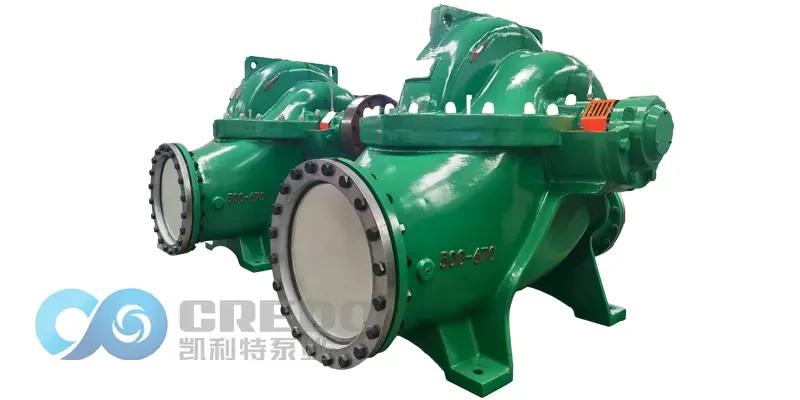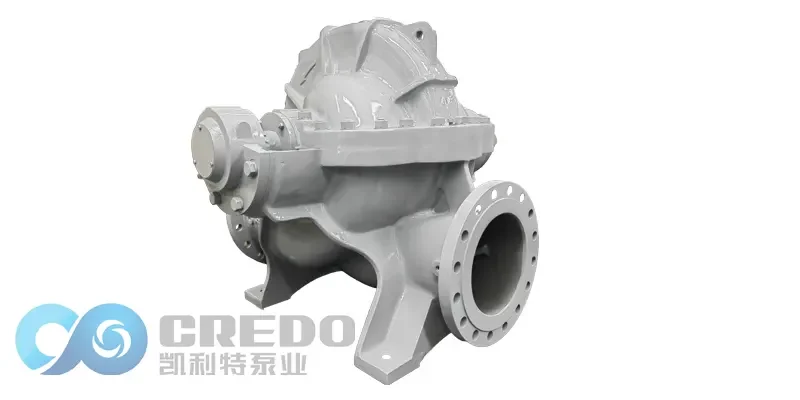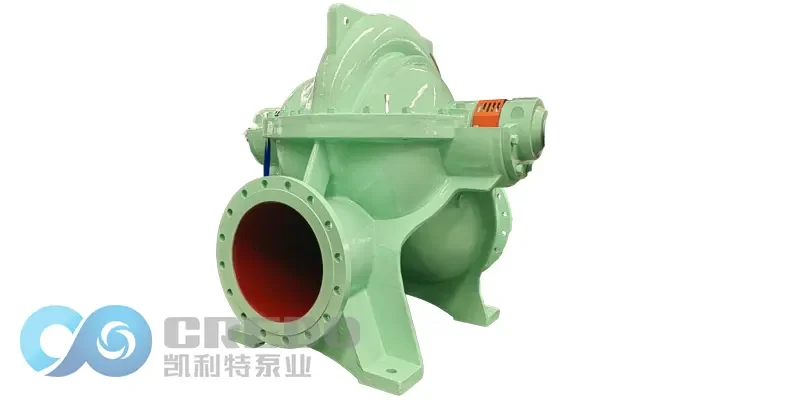
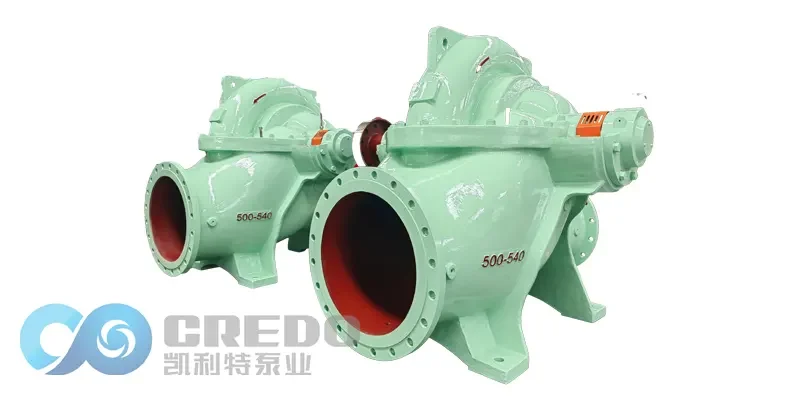
How to Calculate the Head of Double Suction Split Case Pump
Understanding the calculation of pump head is essential for selecting and operating a double suction split case pump efficiently. This type of pump is widely used in HVAC systems, municipal water supply, and industrial applications due to its high flow capacity, stable performance, and energy-saving design. This guide explains the core parameters—flow, head, and power—along with practical head estimation methods.
1. Flow Rate
The flow rate, also known as water delivery volume, is the amount of fluid transported by the pump per unit of time. Represented by the symbol Q, it is typically measured in liters per second (L/s), cubic meters per second (m³/s), or cubic meters per hour (m³/h).
2. Head
The head of a double suction split case pump is the vertical height that the pump can lift water, represented by the symbol H (meters). It includes two components: suction head (the height from the water source to the impeller centerline) and discharge head (the height from the impeller centerline to the outlet surface). Therefore, the total pump head equals suction head plus discharge head. It’s important to note that the head shown on a pump’s nameplate does not include pipeline friction losses, which must be accounted for when selecting a pump.
3. Power
Power, denoted by N, refers to the work done by the pump per unit time. It is typically measured in kilowatts (kW) for electric motors and horsepower (HP) for diesel engines. Shaft power is the actual input power delivered to the pump shaft. Due to mechanical and hydraulic losses within the pump—such as bearing friction, impeller resistance, and flow turbulence—not all input power is converted into useful output power.
4. Pump Head Calculation and Estimation
For example, if the head H = 32 meters, it means the double suction split case pump can raise water to a vertical height of 32 meters. The flow rate can be calculated using: Flow = Cross-sectional Area × Flow Velocity (velocity to be measured manually using a stopwatch and flow meter).
The head of a pump is not directly determined by power but is instead influenced by impeller diameter and the number of impeller stages. For the same power, a high-head pump has lower flow, and a low-head pump has higher flow. Pump outlet pressure readings can provide head estimations (e.g., 1 MPa ≈ 100 meters head), but suction pressure should also be considered.
5. Example: Estimating Double Suction Split Case Pump Head for HVAC System
For a 100-meter-high building HVAC chilled water system:
• Chiller resistance: 80 kPa (8m head)
• Pipeline resistance: Total 140 kPa (14m head) — including 50 kPa in mechanical room, 60 kPa friction, 30 kPa local resistance
• Air terminal unit resistance: 45 kPa (4.5m head)
• Two-way valve resistance: 40 kPa (4m head)
• Total resistance: 305 kPa (30.5m head)
• Add 10% safety margin: 30.5m × 1.1 = 33.55 meters total pump head
In conclusion, accurately estimating the required head for a double suction split case pump is crucial to ensure system efficiency and avoid over-sizing. Oversized heads can lead to unnecessary energy consumption, while under-sizing can result in performance failure. By understanding flow, head, and power, and factoring in system resistance, you can select the optimal double suction split case pump for your application.