How to Calculate the Shaft Power Required for a Vertical Turbine Pump
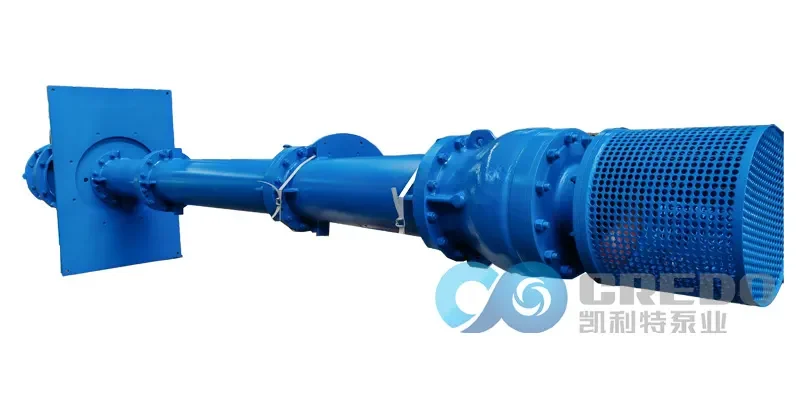
A vertical turbine pump—commonly used in deep well pumping, municipal water supply, irrigation, and industrial processes—operates with high lift and long shaft configurations. To ensure proper motor sizing and energy efficiency, understanding how to calculate the shaft power of a vertical turbine pump is essential.
This guide provides a comprehensive explanation of shaft power calculation, relevant formulas, unit derivations, and how efficiency factors into power selection. Accurate calculation helps avoid motor overload, ensures safe pump operation, and improves energy usage.
1. Standard Formula for Shaft Power Calculation
The shaft power (P) of a vertical turbine pump is derived from the hydraulic power required to lift water and is adjusted based on pump efficiency:
P = (Q × H × ρ × g) / (3600 × η)
Where:
· P: Shaft power (kW)
· Q: Flow rate (m³/h)
· H: Head (m)
· ρ: Liquid density (kg/m³, for water use 1000 kg/m³)
· g: Acceleration due to gravity (9.81 m/s²)
· η: Pump efficiency (decimal form, e.g., 0.75 for 75%)
Simplified empirical version (for water):
P = (2.73 × H × Q) / η
This equation assumes standard water properties (ρ = 1000 kg/m³).
2. Understanding Unit Derivation
The formula’s physical derivation explains how hydraulic energy converts to shaft power:
P = (Specific gravity × Flow × Head × 9.81) / 3600
Breakdown of Units:
· Specific gravity (ρ) = kg/m³
· Flow (Q) = m³/h
· Head (H) = m
· g = 9.81 m/s²
Then:
(kg/m³) × (m³/h) × (m) × (9.81 N/kg) = (N·m) / (3600 s) = Watts
Divide by 1000 to convert to kilowatts (kW).
3. Motor Power Selection Based on Shaft Power
Once the shaft power (Ne) is known, motor power (P) is selected using a safety coefficient K (accounts for mechanical losses and safety margin):
P = Ne × K
Where typical values of K are:
| Shaft Power (kW) | Safety Factor K |
| ≤ 22 | 1.25 |
| 22–55 | 1.15 |
| > 55 | 1.10 |
4. Special Case: Slurry Pump Shaft Power
When the vertical turbine pump is used in applications involving slurry or high-density fluid:
N = (H × Q × A × g) / (3600 × η)
Where:
· A: Slurry density (kg/m³)
· g: Gravity acceleration (9.81 m/s²)
· η: Pump efficiency
· Q: Flow rate (m³/h)
· H: Head (m)
Motor power must also account for:
· Drive type efficiency:
o Direct drive = 1.0
o Belt drive = 0.96
· Safety factor: typically 1.2
5. Understanding Pump Efficiency
Pump efficiency (η) measures how much shaft power is converted into useful hydraulic power:
η = Pe / P
Where:
· Pe: Effective hydraulic power
· P: Shaft power input
Hydraulic Power Formula:
Pe = ρ × g × Q × H (W)
or
Pe = (γ × Q × H) / 1000 (kW)
Where:
· γ = ρ × g is the specific weight (N/m³)
Mass flow rate:
Qm = ρ × Q (kg/s or t/h)
Conclusion
Understanding how to calculate the shaft power of a vertical turbine pump is essential for proper motor sizing, system efficiency, and long-term equipment reliability. Whether handling clear water or slurry, applying the correct formulas and accounting for pump efficiency ensures you select the right motor power and avoid unnecessary energy consumption or equipment damage.
Regularly reviewing efficiency metrics and revisiting pump performance calculations can lead to smarter design choices and better ROI over the pump’s lifecycle.