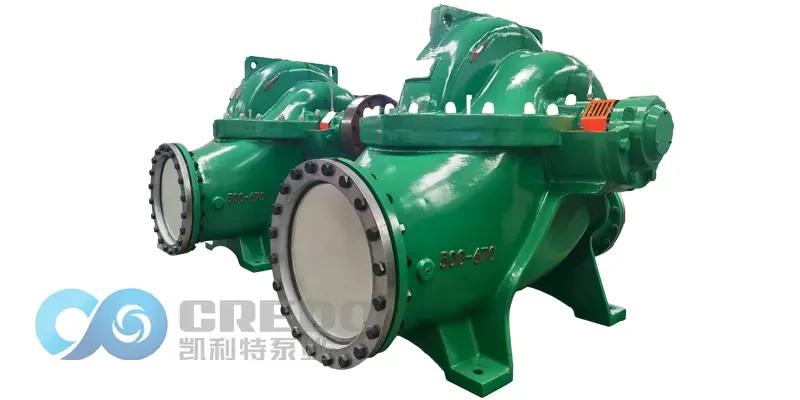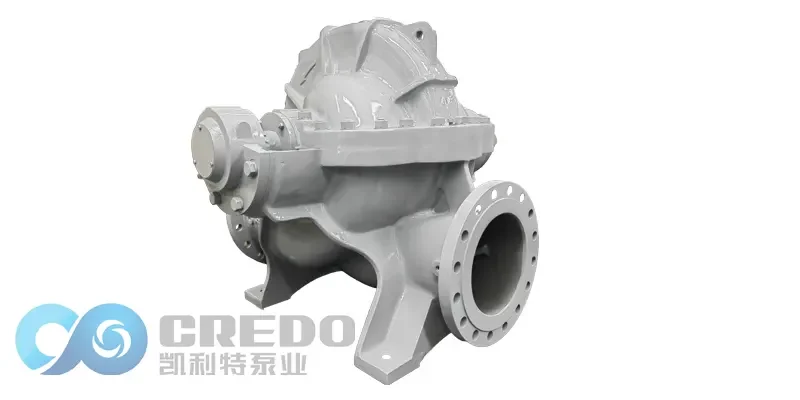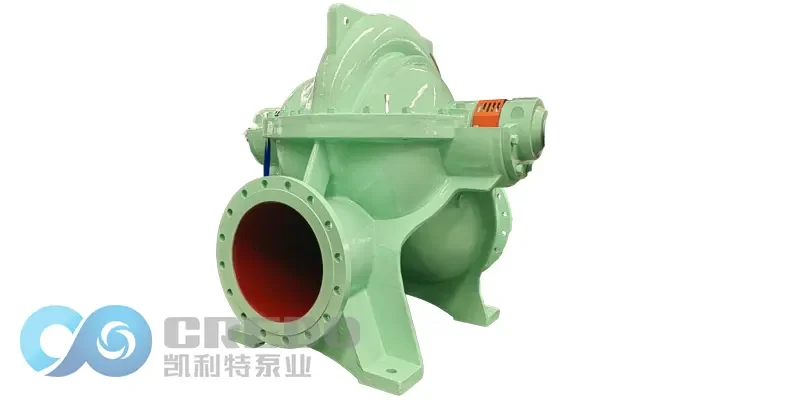

How to Eliminate Cavitation Risks from Inlet Eccentricity in Axial Split Case Pumps
In the installation of an axial split case pump, one critical design detail is often underestimated: the configuration of the eccentric reducer at the suction inlet. Incorrect orientation or improper connection can introduce air pockets, unstable inlet flow, and localized pressure losses—ultimately leading to cavitation, performance degradation, and mechanical damage.
This article explains how eccentric reducers should be installed based on suction flow direction, why orientation matters from a hydraulic perspective, and how proper inlet design directly affects pump efficiency, reliability, and service life.
Why Eccentric Reducer Orientation Matters
In axial split case pump systems, the suction pipeline is typically arranged horizontally, requiring a transition from a larger main pipe to a smaller pump inlet diameter. This transition is commonly achieved using an eccentric reducer.
According to widely accepted pump piping standards and best practices:
Upward flow: use a top-flat eccentric reducer to prevent air accumulation.
Downward flow: use a bottom-flat eccentric reducer to prevent liquid or sediment pockets.
This guideline is often summarized as:
“Top flat for upward flow, bottom flat for downward flow.”
Correct orientation ensures a fully flooded suction condition and prevents gas accumulation at the pump inlet—one of the most common contributors to cavitation in axial split case pumps.
Understanding Cavitation in Axial Split Case Pumps
What Is Cavitation?
Cavitation occurs when the pressure at the pump inlet (impeller eye) drops below the vapor pressure of the liquid. Under these conditions, vapor bubbles form and subsequently collapse as they move into higher-pressure regions within the impeller. This phenomenon causes:
Excessive vibration and noise
Reduction in flow rate, head, and efficiency
Progressive erosion of impeller blades and casing surfaces
How Cavitation Develops
Axial split case pumps rely on a low-pressure zone at the impeller inlet to draw fluid into the pump. If inlet pressure is reduced excessively—due to elevation differences, poor suction piping design, or trapped air—vapor bubbles begin to form.
In practical terms, cavitation occurs when the effective suction pressure at the impeller inlet falls below the liquid’s vapor pressure. Poor inlet geometry, including incorrectly oriented eccentric reducers, accelerates this pressure drop and increases cavitation risk.
Best Practices to Prevent Cavitation in Axial Split Case Pumps
| Category | Best Practice | Technical Explanation |
| 1. Eccentric Reducer Orientation | Upward suction: install top-flat reducer | Prevents air accumulation at the top of the suction line |
| Downward suction: install bottom-flat reducer | Avoids air pockets and ensures full-pipe flow | |
| Air trap prevention | Proper orientation eliminates gas accumulation at the pump inlet | |
| 2. Suction Piping Design | Use larger-diameter pipes | Reduces inlet velocity and friction losses |
| Short, straight suction line | Minimizes turbulence and pressure drop | |
| Minimize bends and valves | Reduces local head losses | |
| Avoid upward-sloping suction lines | Prevents air entrapment, especially with horizontal inlets | |
| 3. Fluid Property Control | Maintain low liquid temperature | Lowers vapor pressure and cavitation tendency |
| Ensure clean medium | Prevents sediment buildup and flow disturbance | |
| Sediment risk mitigation | Use bottom-flat reducers where solids may accumulate | |
| 4. Increasing NPSHa | Elevate suction tank | Increases static suction head |
| Use flooded suction | Maximizes NPSHa and stabilizes inlet conditions | |
| Reduce inlet resistance | Minimizes suction-side friction losses |
Role of Eccentric Reducers in Cavitation Control
While the above measures address cavitation prevention from a system-level perspective, the eccentric reducer remains a critical local component at the pump suction. Improper reducer selection or installation can negate otherwise sound piping design.
Function and Installation Guidelines of Eccentric Reducers at Pump Inlet
| Item | Description |
| Primary function | Smooth transition of pipe diameter and reduction of fluid velocity |
| Hydraulic benefit | Prevents turbulence and uneven inlet flow |
| Relevance to axial split case pumps | Stable, uniform suction flow is essential for cavitation-free operation |
| Recommended location | Install the reducer as close as possible to the pump inlet |
| Elbow coordination | Avoid placing reducers immediately after upward elbows unless orientation is strictly correct |
| Cavitation prevention role | Proper reducer positioning significantly lowers cavitation probability |
Conclusion
For optimal performance of an axial split case pump, careful attention must be given to suction-side piping design—particularly the orientation and placement of eccentric reducers. Correct configuration prevents air entrapment, stabilizes inlet pressure, reduces cavitation risk, and extends pump service life.
By understanding the hydraulic principles governing suction flow and pressure balance, engineers and operators can avoid costly failures, unplanned downtime, and premature equipment wear. Whether designing a new pump station or optimizing an existing installation, proper eccentric reducer selection and suction layout should always be treated as a critical design priority.