Common Methods and Practical Guidelines for Cavitation Performance Testing of Vertical Turbine Pumps
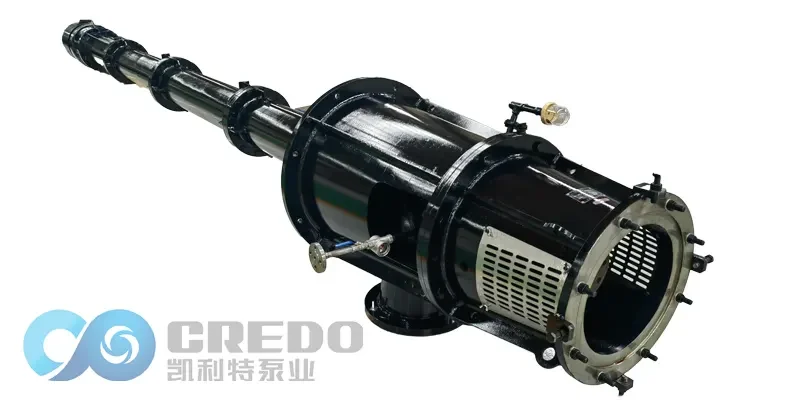
Cavitation is a hidden threat to the reliable operation of vertical turbine pumps, leading to vibration, noise, and impeller erosion, which can ultimately cause catastrophic failures. Due to their unique structure—long shafts often reaching tens of meters—and complex installation, determining cavitation performance (NPSHr) poses significant engineering challenges. This guide provides an overview of common testing methods, practical guidelines, and recommendations for optimizing pump design and operation.
1. Importance of NPSHr Testing
The Net Positive Suction Head required (NPSHr) is a critical parameter for evaluating cavitation resistance. Accurate NPSHr testing allows engineers to:
Predict the onset of cavitation.
Optimize pump design and impeller geometry.
Extend service life and minimize maintenance costs.
Ensure stable operation in dynamic industrial environments.
2. NPSHr Testing Methods
The table below summarizes the main testing methods for vertical turbine pumps, highlighting principles, procedures, challenges, suitability, and accuracy.
| Test Type | Principles / Equipment | Procedure / Key Points | Challenges / Notes | Pump Type / Suitability | Accuracy / Reliability | Industry Application |
| Closed-Loop Test Rig | Closed-loop system with vacuum pump, stabilizer tank, flowmeter, and pressure sensors for precise inlet pressure control | • Fix pump speed & flow rate • Gradually reduce inlet pressure until head drops 3% • Record critical pressure & calculate NPSHr | • Space limitation: ≤5 m vertical height • Dynamic behavior distortion due to short shafts | Short-shaft deep-well pumps (shaft ≤5 m) | ±2%, ISO 5199 | Prototype R&D; impeller optimization (case study: NPSHr reduced 22% after 200 tests) |
| Open-Loop Test Rig | Open system using tank liquid levels or vacuum pumps; upgraded with high-accuracy differential transmitters (≤0.1% FS) & laser flowmeters (±0.5%) | • Modulate inlet pressure • Measure flow, head, pressure | • Deep-well simulation: construct underground shafts ≥ pump shaft length • CFD corrections for inlet losses | Medium to long-shaft pumps | ±0.5–1% | Large pump verification; long-shaft immersion conditions |
| Field Testing | Real-world operational adjustments via valve throttling or VFD speed | • Install high-accuracy pressure sensors at inlet flange • Gradually close inlet valves, record flow, head, pressure • Plot head vs. inlet pressure curve | • Pipe vibration → anti-vibration mounts • Gas entrainment → inline gas monitors • Accuracy → average multiple measurements, analyze vibration spectra (1–4 kHz for cavitation onset) | All pump sizes | Medium | Operational validation; verifies actual NPSHr under working conditions |
| Scaled-Down Model Testing | Based on similarity theory; maintain specific speed ns; scale impeller: Qm/Q=(Dm/D)³, Hm/H=(Dm/D)² | • 1:2–1:5 scale models • Replicate materials & surface roughness | • Scale effects: Reynolds deviations → turbulence corrections • Surface roughness: polish Ra ≤0.8 μm | Any pump type for prototyping | ±5–10% | Cost-effective R&D; fits standard test rigs; reduces testing cost 10–20% of full-scale |
| Digital Simulation | CFD (3D full-flow-path, multiphase, cavitation models, e.g., Schnerr-Sauer) & Machine Learning prediction | • CFD: iterate to 3% head drop, extract NPSHr • ML: input impeller parameters (D₂, β₂, etc.) to predict NPSHr | • CFD validation ≤8% deviation from physical tests • ML: reduces need for physical testing, cuts design cycle by 70% | All pump sizes | CFD ±8%; ML predictive | Rapid virtual testing; multiple design options; early optimization |
3. Practical Guidelines
Combine Methods for Accuracy
Short-shaft pumps: closed-loop or scaled-down model testing.
Long-shaft deep-well pumps: field testing + digital simulation.
Prototype verification: combine scaled-down and CFD/ML simulations.
Optimize Data Quality
Use calibrated sensors and high-precision instruments.
Average multiple measurements and account for vibration/gas entrainment.
Apply CFD corrections for pipeline losses when necessary.
Leverage Digital Tools
CFD modeling allows pre-testing optimization of impeller geometry.
Machine learning can predict NPSHr across different pump designs, reducing physical testing.
Documentation and Standard Compliance
Record all test data for maintenance, troubleshooting, and design validation.
Follow ISO 5199, API 610, or relevant national standards for pump testing and safety.
4. Conclusion: From Empirical Guesswork to Quantifiable Precision
Historically, cavitation testing for vertical turbine pumps was limited by misconceptions about long shafts and complex installations. By integrating:
Closed-loop and open-loop rigs,
Field validation,
Scaled-down models,
Digital simulations (CFD + ML),
engineers can accurately quantify NPSHr, optimize pump design, and improve maintenance strategies. As hybrid testing and AI tools become standard, achieving full visibility and control over cavitation performance will no longer be a challenge, ensuring safer, more efficient, and longer-lasting pump operation.