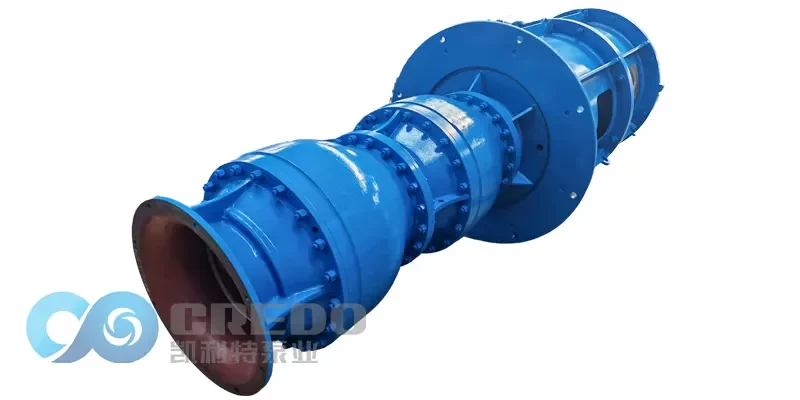
What Affects the Performance Curve of Submersible Vertical Turbine Pumps?
1. Understanding the “Pump Curve” vs. the “Impeller Segment Curve”
Manufacturer-provided performance curves for submersible vertical turbine pumps are usually obtained under ideal laboratory conditions: precise installation, clean water, ambient temperature, and standard atmospheric pressure. These curves are commonly referred to as the impeller segment curve (also known as the bowl performance curve or above-ground curve).
The impeller segment curve represents the pure hydraulic capability of the pump’s core (bowl assembly) and does not include losses introduced by long shafts, bearings, seals, or discharge components.
In real installations, however, the actual operating pump curve differs from the impeller segment curve because it must account for transmission losses throughout the pump system.
Actual Pump Performance Curve = Impeller Segment Curve − Transmission Losses
2. Sources of Transmission Losses
Transmission losses arise from multiple hydraulic and mechanical factors along the pump assembly.
| Loss Category | Main Source | Description |
| Transmission Shaft Losses | Shaft & guide bearings in water | Hydraulic friction from rotating shafts and bearings submerged in liquid |
| Mechanical Losses | Bearings (water- or oil-lubricated) | Friction between shaft and guide bearings, especially in long-shaft designs |
| Pump Casing Losses | Discharge elbows & casing | Hydraulic resistance due to flow direction changes and geometry |
| Packing / Seal Losses | Packing or mechanical seals | Friction losses at shaft sealing points |
3. How Actual Performance Differs from the Impeller Segment Curve
Because of the above losses, the actual operating curve shows systematic deviations from the nominal impeller segment curve.
| Performance Aspect | Actual Pump vs. Impeller Segment Curve |
| Head | Lower head at the same flow rate due to cumulative hydraulic and mechanical losses |
| Efficiency | Reduced overall efficiency caused by additional friction and transmission power losses |
| Shaft Power | Higher required input power to overcome transmission losses |
| Shutoff Head | Relatively small difference, as hydraulic losses are minimal at zero flow |
4. Key Factors Influencing the Deviation Between Curves
4.1 Total Pump Length (Shaft Length)
Impact: One of the most critical influencing factors.
As shaft length increases:
The number and total weight of shaft sections increase
More intermediate guide bearings are required
Frictional surface area in the fluid increases
Risk of shaft deflection and torsional deformation rises
Result: Higher hydraulic and mechanical transmission losses, increased power demand, reduced head, and a noticeable drop in efficiency.
In practice, manufacturers estimate these losses based on total pump head (immersion depth + discharge pressure) and adjust motor power during selection.
4.2 Pump Speed (RPM)
Impeller Segment Laws (Affinity Laws):
Flow: Q ∝ N
Head: H ∝ N²
Power: P ∝ N³
Transmission Loss Trend: Transmission losses increase approximately with N² to N³.
Result: When speed is adjusted using a VFD, actual efficiency often drops faster than predicted by the theoretical impeller curve, especially at lower speeds. The real head curve may also deviate from the ideal H ∝ N² relationship.
4.3 Transport Medium Properties
| Medium Property | Impact on Performance |
| Viscosity | Significantly increases hydraulic and bearing friction losses; reduces head and efficiency; raises shaft power |
| Density | Mainly affects power (P ∝ ρ); heavier liquids require higher drive power |
| Solid Content / Abrasiveness | Accelerates wear of impellers, bearings, sleeves, and seals; degrades hydraulic surfaces and causes long-term curve deterioration |
Key Note: For viscous or solids-laden media, the nominal water-based impeller segment curve must be corrected carefully.
4.4 Installation Accuracy and Operating Condition
| Factor | Effect on Performance |
| Shaft Alignment | Poor alignment increases vibration and friction losses |
| Bearing Condition | Worn or loose bearings increase losses and vibration; seizure can cause catastrophic failure |
| Seal Condition | Over-tight packing raises power consumption; seal failure leads to leakage and inefficiency |
| Internal Scaling / Clogging | Blocks flow passages, increases resistance, and causes major deviation from designed head and flow |
5. Summary and Practical Recommendations
Key Conclusions:
The impeller segment curve represents ideal hydraulic performance only.
Actual pump performance always shows lower head, lower efficiency, and higher power demand.
Total shaft length is one of the most decisive factors influencing transmission losses.
Speed variation, medium properties (especially viscosity and solids), and installation quality strongly affect curve deviation.
6. Recommendations for Selection, Operation, and Maintenance
During Selection:
Provide accurate site data: medium properties, temperature, viscosity, solids content, required flow/head range, and installation depth
Ensure the supplier accounts for both impeller performance and estimated transmission losses
Verify required motor power, expected operating point, and efficiency range
Confirm sufficient NPSHA margin over NPSHR to avoid cavitation
Select models operating close to the BEP for long-term reliability
During Operation & Maintenance:
Monitor current, pressure, vibration, noise, and temperature
Compare operating data with baseline curves to detect performance degradation
Regularly inspect shaft alignment, bearing clearances, and seal conditions
Implement periodic cleaning plans for scaling or solids-prone services
By clearly understanding the composition of pump performance curves and the factors that cause deviations, users can make better-informed decisions during selection, installation, commissioning, and long-term operation—ensuring efficient, stable, and reliable performance while maximizing service life.